Finds apps that shut down while people still wanted them
A plugin scraper pipeline that reads replacement requests and ranks the gaps worth building into.
What was in the way
When a popular app shuts down, the people who relied on it go looking for a replacement in public. That demand is visible for a while, then it disperses and the opportunity closes with it.
Spotting it by hand means reading the same forums every day and remembering what you already read. Nobody sustains that for long.
How it was built
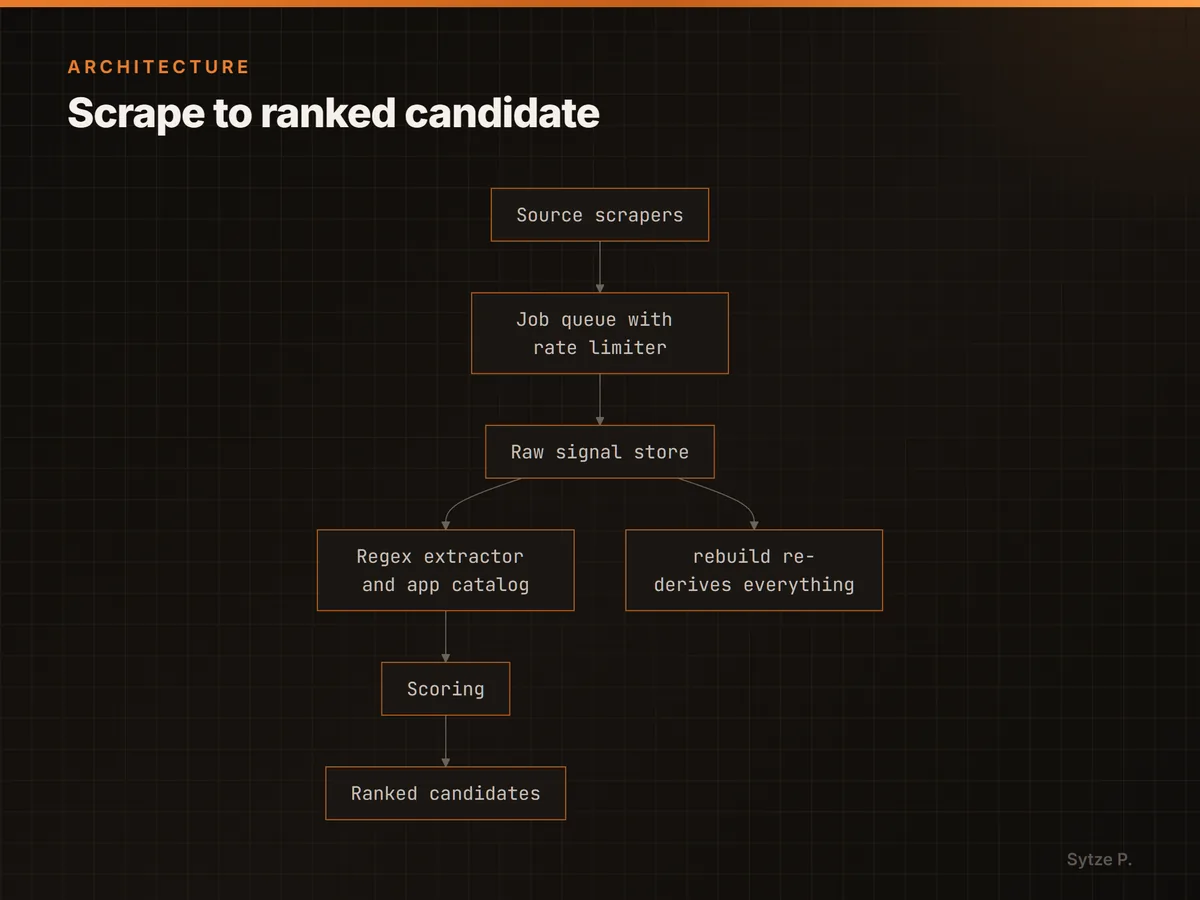
Each source is an isolated scraper file dropped into a registry, so adding one never means refactoring the others. A job queue with rate limiting feeds them, and the store is SQLite in write-ahead mode with durable cursors, so a hard crash resumes instead of starting over.
Extraction is deliberately regex and a curated app catalog rather than a language model. These signals are short and formulaic, so a model would add cost and non-determinism without buying accuracy. A rebuild command re-derives every signal from the raw captures, which is the safety net for the day an extractor turns out to be wrong.
How it works
Scrapers are drop-in
A new source is one file added to the scrapers directory. Nothing else in the pipeline changes to accept it.
Survives a hard crash
Write-ahead logging and durable cursors mean an interrupted run picks up where it stopped rather than re-scraping from the start.
Wrong extractor is not a lost dataset
Raw captures are kept, so a rebuild truncates the derived tables and replays everything through the fixed extractor.